Energy Storage Systems: Why BESSs Are Becoming Strategic for Businesses and Public Administration
From photovoltaic integration to energy cost reduction: storage development opens up new industrial and financial opportunities.
The growth of renewable energy sources is profoundly changing the functioning of the Italian energy system. The increase in production from photovoltaic and wind power, which by their very nature are unpredictable, makes it increasingly important to be able to store energy produced during peak availability and use it when the system, a business, or a public facility actually needs it.
In this scenario, BESS (Battery Energy Storage Systems) no longer represent just an accessory component of photovoltaic systems, but a truly strategic infrastructure.
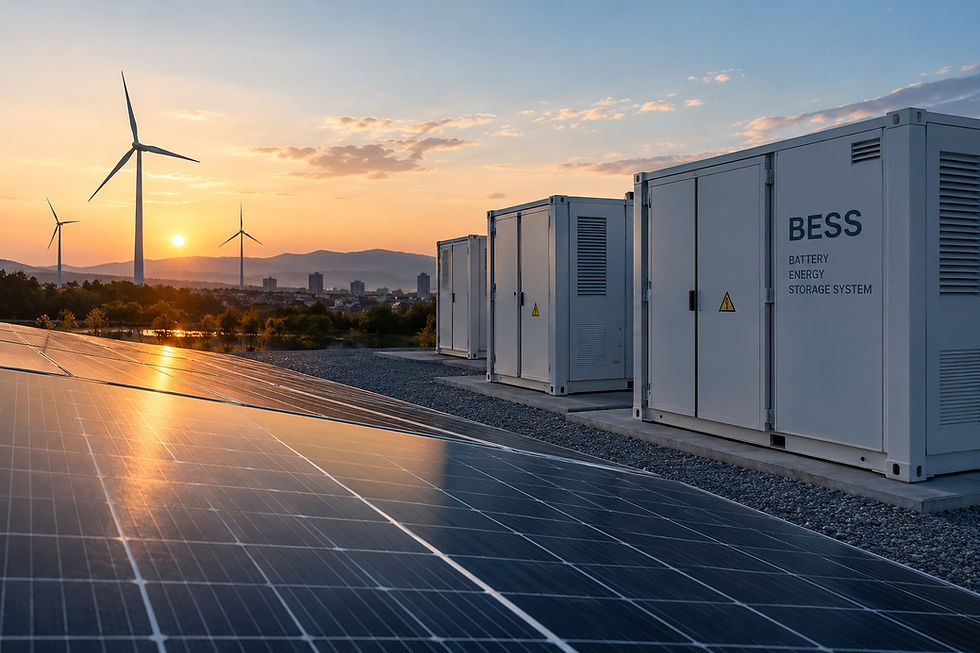
For businesses, they can mean increased self-consumption, reduced grid peaks, lower energy costs, and greater operational continuity. For public administrations, they can become tools for improving the efficiency of schools, hospitals, water systems, and other public infrastructure. Finally, on a national scale, storage contributes to grid stabilization and greater integration of energy produced from renewable sources.
Why storage is becoming increasingly important
The progressive electrification of consumption and the increase in renewable production make an increasingly flexible energy system necessary.
Photovoltaic systems, for example, concentrate a significant portion of their production during the central hours of the day, which do not necessarily coincide with peak demand. Storage allows the use of this energy to be spread over time, reducing waste and increasing self-consumption capacity.
The principle is relatively simple: store energy when it is available and use it when its economic or industrial value is greatest.
This function gives rise to very different business models depending on whether the storage system is installed to serve a company or is built as a true power plant connected to the grid.
Behind-the-Meter and Utility-Scale: Two Different Models
A first fundamental distinction concerns Behind-the-Meter systems, generally installed directly in industrial plants, commercial structures or public buildings.
In this case, the BESS is mainly used to increase self-consumption of the photovoltaic energy produced, reduce peaks in grid withdrawals through so-called peak shaving, and improve overall energy consumption management.
For some production facilities, it can also contribute to the continuity and quality of the electrical power supply.
The function of Front-of-the-Meter or Utility-Scale systems, i.e. storage plants directly connected to the electricity grid, is different.
These plants can operate on energy markets, purchasing and storing energy during peak availability hours and making it available later, as well as providing services that help maintain grid stability and balance.
The distinction is crucial because it profoundly changes the economic model, financial structure, authorization process, and the profile of the investors involved.
Industrial BESS as a cost management tool
For a company, the evaluation of a storage system should first start with an analysis of its own consumption.
It is important to understand when energy is used, what the main absorption peaks are, how much the photovoltaic system produces, what portion of the energy produced is already self-consumed and how much is fed into the grid.
Only then can the size and configuration of the storage system be correctly determined.
Project implementation therefore requires a process that includes diagnosis and sizing, verification of the authorization process, analysis of the grid connection, technology selection, procurement, financing, installation, and subsequent Operation & Maintenance activities.
Of particular interest is the case of energy-intensive companies or those characterised by highly variable consumption throughout the day.
In these situations, the economic return on the investment can derive from the combination of several benefits: increased self-consumption, peak shaving, optimization of energy purchases, and long-term asset valorization.
It is the principle of so-called revenue stacking , that is, the possibility of building the economic sustainability of the project through multiple sources of benefit or income.
The role of incentives and subsidized finance
The sustainability of investments in photovoltaics and storage can be significantly influenced by the presence of public incentives and support tools.
For businesses, integrating storage systems into broader self-generation and energy efficiency projects can significantly improve the financial return on their investment, where the requirements set forth in the individual measures are met.
For this reason, the analysis of incentives should not take place after the technical definition of the project, but should be integrated into the initial planning phase.
The investment structure must be constructed by simultaneously evaluating technical characteristics, expected energy savings, available incentives, financing methods, and capital return times.
MACSE and large storage plants
For utility-scale plants, MACSE, the Electric Storage Capacity Procurement Mechanism, is of particular importance.
The system aims to support the development of new storage capacity necessary for the functioning of the electricity system, through competitive mechanisms and long-term contracts.
The ability to make a plant's cash flows more predictable is a particularly important element from a financial perspective, as it can help reduce investment risk and facilitate its bankability.
This is also why storage is increasingly becoming attractive not only to traditional industrial operators, but also to infrastructure funds, institutional investors, energy developers, and financial operators.
How to finance a BESS project
The financial structure depends primarily on the size and nature of the project.
For a system installed at an industrial facility, corporate financing, leasing, or other forms of debt can be used, in which repayment is also supported by the energy savings produced by the investment.
Another solution is represented by the ESCo or As-a-Service models, in which a third party finances, builds, and manages the system, while the company benefits at least partially from the savings generated without directly bearing the entire initial investment.
For large storage plants, however, the use of Project Finance may become more appropriate, especially when the project has sufficiently predictable revenue flows.
In addition to bank financing, equity, private debt, minibonds, and other complementary finance instruments can also be used, even in the development phases preceding the asset's full construction readiness.
The bankability of a BESS therefore depends not only on the value of the technology, but on the ability of the entire project to generate sustainable economic flows over time.
From technology to bankable project
Buying a battery does not automatically mean you have made a sustainable investment.
A BESS project requires careful evaluation of the authorization process, grid connection conditions, system safety, the technology used, and battery performance guarantees and degradation.
Particular attention must be paid to battery life and the warranties offered by manufacturers, as well as the proper management of safety and prevention systems. Grid connection times can also be one of the most critical elements in project development.
A bank or investor, therefore, doesn't just evaluate the cost of the storage system. They analyze the entire asset: permits, connectivity, technology, EPC and O&M contracts, revenue structure, counterparty solidity, available incentives, and the project's ability to generate adequate cash flows.
The role of Italiano & Partners
Italiano & Partners supports companies, developers, and other stakeholders in the energy sector in structuring BESS projects through an integrated legal, strategic, and financial approach. This includes support in analyzing the authorization and contractual framework, defining the business model and transaction structure, identifying incentives and subsidized financing options, and developing financing solutions through banks, investors, and financial institutions. The goal is to guide the project from the initial evaluation phase through its structuring as a concretely feasible, sustainable, and bankable investment.
Storage as a new industrial infrastructure
The real transformation underway concerns the very role of energy within corporate strategies.
Photovoltaics, storage systems, energy efficiency, incentives and financial instruments can no longer be evaluated separately.
For a company, deciding to invest in a BESS means simultaneously evaluating its consumption profile, energy costs, planned industrial investments, the cost of capital, and the expected return on the operation.
For a developer, it means building a licensed, technically reliable asset, connected to the grid, and with a sufficiently robust economic structure to attract capital.
It is precisely from the integration of energy, strategy, law, and finance that a new generation of infrastructure can emerge, capable of supporting the competitiveness of businesses and, at the same time, contributing to the transformation of the Italian energy system.


Comments